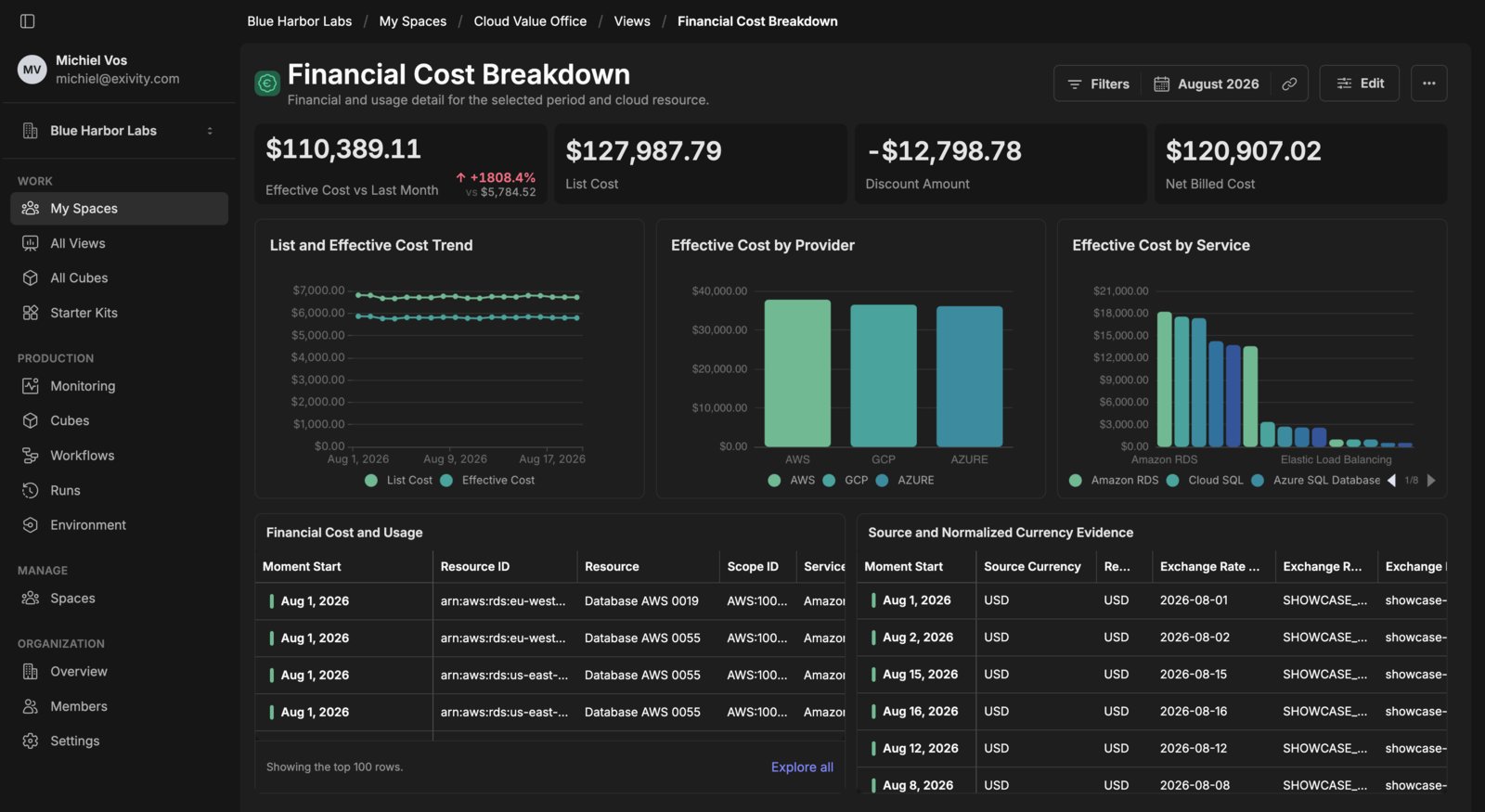


Three failures every billing team recognises
Thousands of SKUs across platforms that were never designed to be billed together. The failures are the same at every provider.
A new service takes a quarter to bill
The platform is live and the contract is signed. Usage sits in a portal nobody can export. Revenue waits on a connector.
Two numbers for the same customer
The billing system says one thing. The report you send the customer says another. Someone spends the month reconciling.
Margin per customer is a spreadsheet
Cost to serve lives in a quarterly exercise, not in a view you can open. Unprofitable customers stay that way.
Meter the platforms you sell
Public cloud, private cloud, containers, bare metal, licences, and managed services in one place. Connect supported platforms with extractor templates, and map other accessible data through the generic extractors.
Hybrid and private platforms
Bare metal and hardware
Services, licences, and everything else
Something not listed? Every integration, and the REST extractor for the rest →
Your contract, applied once.
Public cloud hands you a price. A cluster you bought does not, and the customer’s contract adds tiers, floors, and credits on top. All of it is applied per customer, and the derivation is kept.
Tiers and commitments
Volume and graduated tiers, minimum commitments, proration. Per customer, per period, versioned.
Uplifts, discounts, credits
Resold cloud with an uplift. A credit that hangs off the line it corrects. Microsoft NCE and Azure CSP terms included.
Per-customer rate cards
Each customer gets its own rates. Change one card and one customer changes.
Derived rates for private infrastructure
Rate equals cost base divided by the measured driver. The derivation is kept, not just the answer.
Distributor, reseller, end customer. Each with its own rates and its own view.
One hierarchy, three rate cards, three scoped reports. Nobody sees a level above their own.
- L1DistributorRateswholesale rate cardSeesevery reseller and their customers
- L2ResellerRatesretail rate cardSeestheir own customers only
- L3End customerRatescontract ratesSeestheir own charges only
Billable in one cycle, not one project.
A billing team is judged on one number: how many cycles pass between a service going live and its first invoice. Four steps, and none of them waits on a vendor.
- 01Point an extractor at the platform
Templates for common platforms. Map the fields, run, and the usage is in the model.
- 02Preview every transform on real rows
See what a rule does before it touches a period. No surprises at close.
- 03Rate, report, and schedule it
Extract, transform, rate, and report on a schedule. Webhooks when a run finishes or fails.
- 04Run one cycle in parallel, then cut over
Bill alongside your current process. Switch when the figures agree.
Margin per customer becomes a report, not a spreadsheet
Each customer gets a space of their own. Access is scoped to their data. Sensitive fields are hidden. Their rate structure applies as charging rules. Repeatable per customer, without duplicating the model.
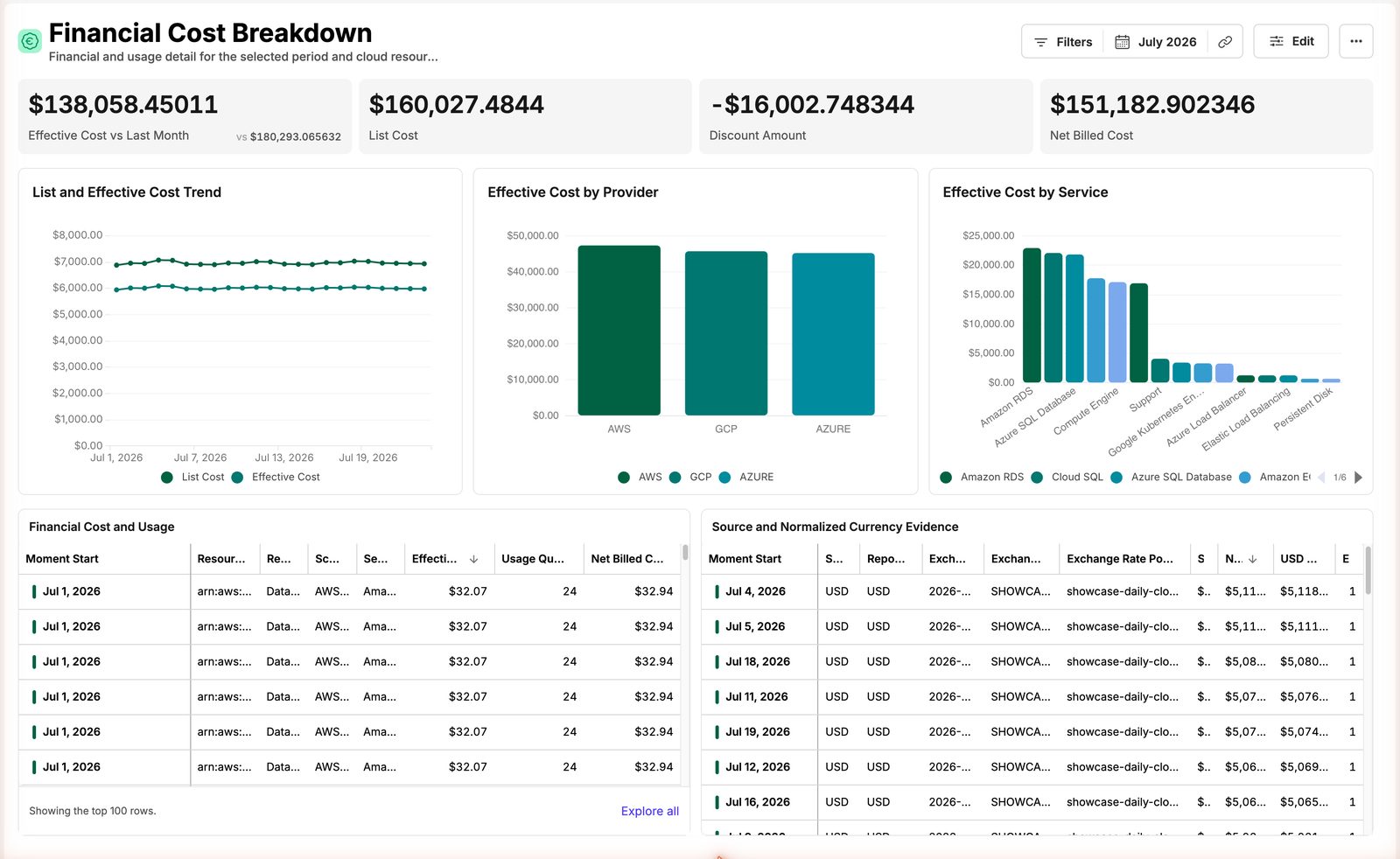
Once billing data is modelled, cost to serve and margin per customer are a view you open, not a quarterly exercise.
Before you talk to sales
The questions we hear most often, answered directly.
Ask us the restWe already have a billing system.
Keep it. Exivity Core meters and rates, then hands invoice-ready charges to the system that posts the invoice. The billing system gets rated input it did not have to compute. The report you send the customer and the invoice you post come from the same charge records.
Our customers’ data cannot leave our datacentre.
Exivity Core runs self-hosted on a VM or on Kubernetes, and fully air-gapped where outbound connectivity is not allowed. Cost and usage data never leave your environment.
We resell through partners.
Distributor, reseller, end customer, each with its own rate card and its own scoped view. One hierarchy, no duplicated model, and no level can see the one above it.
How long until the first bill?
It depends on how many platforms you sell and how easily each one gives up its data. The usual path is to meter one platform first, run a billing cycle in parallel with your existing process, and cut over when the figures agree.
Which Exivity product is this?
Exivity builds two products. Hypermeter is SaaS for cross-source cost allocation, FinOps analysis and unit economics. Exivity Core collects and rates usage and supports billing workflows, and can run in your own environment. You do not have to choose before you talk to us: bring the use case and we will recommend one, the other, or both.
Read before you book
Best FinOps tools for MSPs
Most FinOps tools cannot bill a third party. The ones that can, ranked on what billing needs.
Read →LearnChargeback vs showback
What each requires, why most start with showback, and how to build an on-prem rate.
Read →LearnFOCUS, explained
What the FinOps open specification standardises, what it leaves to you, and what to ask a vendor.
Read →Measured on something else?
Cloud Financial Management
Control, allocate and optimize cloud spend
Explore →AI & Token Economics
Understand cost across tokens, models, agents and AI workloads
Explore →Unit Economics & Business Value
Connect cloud and AI spend to customers, services and business outcomes
Explore →Sovereign & Hybrid Cloud
Financial control across cloud and datacentre
Explore →Bill the platform you just launched.
Discuss this use case with an engineer. Bring one platform; leave with the setup that fits your contracts.